Confessions of a Modern-Day Wallflower
A wallflower is someone who tends to stand quietly at the edge of social situations, observing rather than stepping straight into the centre of attention. The term is often used to describe someone shy or reserved in groups. Or, as I rather like to think of it, someone who might take a little longer to warm up, or quite likes being around the action without needing to be right at the centre of it.
Hello you! Let’s talk about the phrase wallflower. Because it’s something many of us have heard, maybe even been called, but rarely paused to unpack. Well, until now because naturally, I’ve decided to investigate 😊
Over time, it’s gathered layers of misunderstanding that can make being called a wallflower feel a little uncomfortable.
Yet the word itself has both botanical and historical roots, and those origins tell a far more interesting story than the stereotype suggests.
So scroll on in and let’s unpack this together.
But before we do dive straight in, here’s a snapshot of what a wallflower really means, for those who prefer things short and sweet:
A Quick Peek at What’s Ahead:
Prefer to skip around? If so, you’ll find the contents below and if you’re wondering how an old episode of Come Dine With Me sent me down this particular rabbit hole, I’ve tucked that story in there too.
👀 → Contents (click to expand):
Contents:
🌱 The Wallflowers True Meaning
🎓 What Can Wallflowers Teach us Shy Souls?
🧱 A Brief History Of Where The Term Wallflower Originated
🎬 Wallflowers in the Modern Day
🌼 A Quiet Reclaiming of the Term Wallflower
An Old Episode of Come Dine With Me
I hadn’t really thought much about the term for a while. But there I was, sitting and wondering what my next shy reflection should be, and I’ll admit I was struggling for inspiration.
Until I stumbled across it.
I’m partial to a rabbit hole or three. Though in my case, it’s less of a hole and more of a crater. Safe to say, it doesn’t take much for me to get completely lost in something.
Usually, there’s at least a hint of educational value (or so I like to tell myself). But lately, I’ve been watching old episodes of the once much-loved British Channel 4 series Come Dine With Me.
Please don’t judge, we all need our downtime and if you haven’t seen it, I do recommend it. Not so much for the cooking, but for the deep dive into human behaviour. (It’s all there on YouTube, waiting for you.)
I’ll admit, I recently began to question why I watch this (I can only lie to myself for so long). I found myself wondering if this was really the best use of my time and energy.
But then, during one of my late-evening viewing sprees, something caught my attention, or rather, it was something someone said.
For Those Unfamiliar
Come Dine With Me involves four strangers who, for reasons beyond me, agree to open their homes and cooking to three other contestants, all while being filmed for TV.
Each takes their turn to host and rate one another in the hope of bagging the £1,000 prize money. Honestly, it’s my idea of a nightmare and the pounds on offer are nowhere near high enough for me to even entertain it. But that’s me.
Throughout the process, each contestant is interviewed away from the group, privately. Supposedly. Although, given that they’re clearly sitting in the host’s bedroom, “private” is questionable at best.
These one-on-one moments are meant for scoring the meal, but more often than not, they become opportunities to complain about, well, everything, including each other. Television gold, apparently.
Clearly for me, too, because I’m hooked. (Another journal prompt for me to unpack someday.)
Anyway, during one particular episode, in the midst of kitchen chaos, a contestant remarked with glee:
“There’s four strangers all talking over each other – how good is that? We’ve got no wallflowers here!”
And There it Was
That word.
A phrase I hadn’t thought about in a while and it rather set me off, my brain was in a flurry. So much so that I didn’t even care about the rest of the episode. It no longer mattered. I paused the video and promptly entered yet another rabbit hole.
I’m glad I did. Thank you, Come Dine With Me, I knew there was a reason I needed to watch it. Whether I have reason enough to continue is another story.
But here’s what I discovered, and why digging into the history and assumptions behind this little word feels unexpectedly important for us shy souls.
Now, that’s the housekeeping out of the way, let’s get curious.
The Social Meaning of a Wallflower
Beyond the dictionary definition, the term wallflower is usually used to describe someone who hangs back in social situations rather than immediately joining in.
So yes, it’s often us shy people who end up being labelled as wallflowers. We might be standing at the edge of the room, listening more than talking or taking a little longer to warm up before we get involved.
Sometimes that’s exactly where we want to be, and other times, perhaps it’s not.
Yet there’s so much more to this term. So allow me to go into the weeds a little on this one, starting from its roots.
The Wallflower’s Botanical Roots
Wallflower, in its botanical sense, is a name given to plants from the Erysimum genus, part of the Brassicaceae family. If that means absolutely nothing to you, you’re not alone. I have zero gardening credentials either.
But apparently, this family has some serious heavyweights in the vegetable world: think broccoli and cabbage. So they’re a healthy bunch.
Wallflowers, rather fittingly, can grow in rocky places and wall crevices, making themselves at home in places other plants might struggle with.
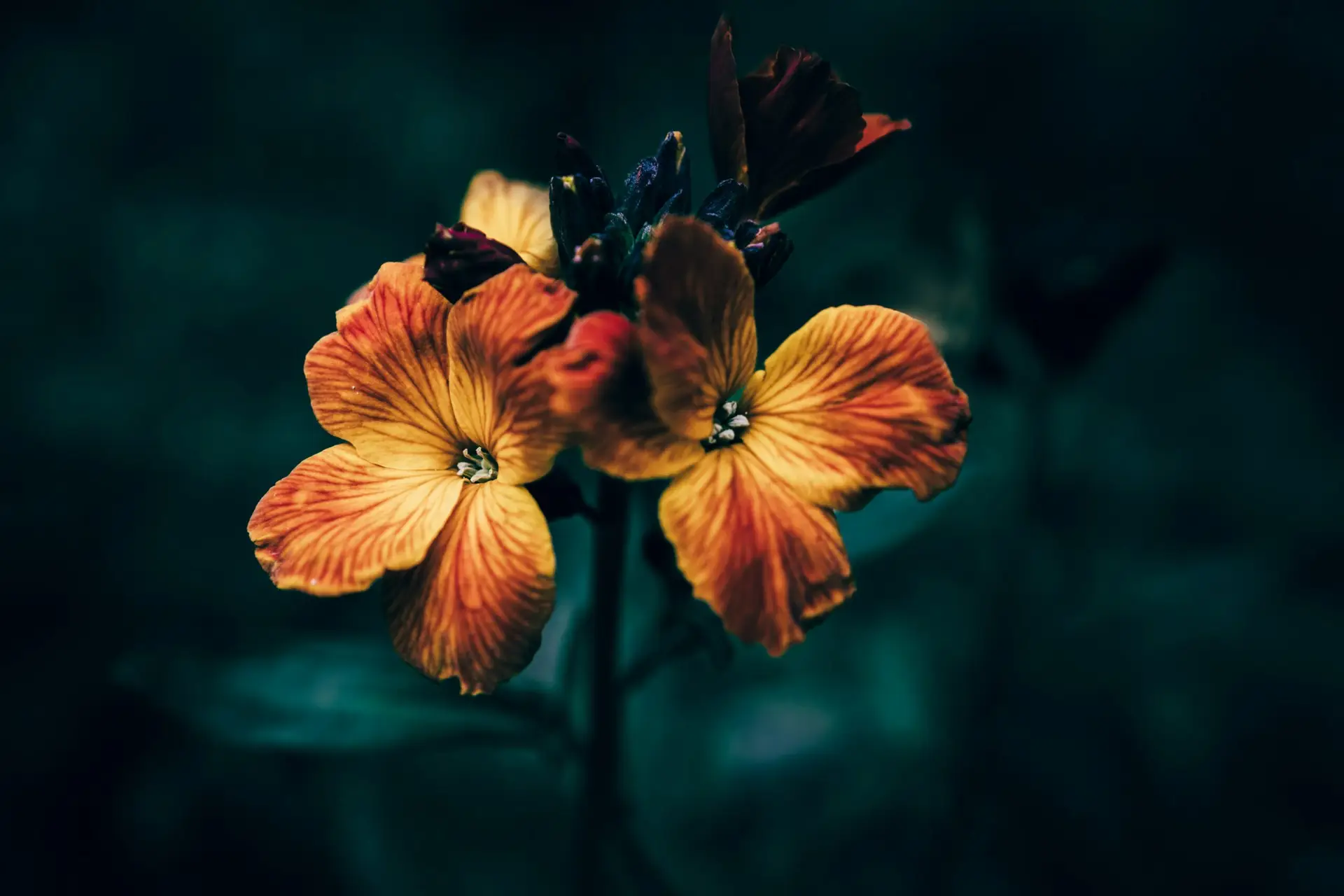
But they’re certainly not dull little things hiding away. Their flowers can be wonderfully colourful and are often fragrant, with varieties ranging from yellows and oranges through to reds, pinks and purples.
But here’s the part I personally love the most. Many wallflowers are grown as biennials, meaning they’re planted one year and flower the next.
So while they may not be flowering straight away, they’re busy getting established first. So when they do bloom, they do it beautifully.
What Can Wallflowers Teach us Shy Souls?
I realise I’m now taking life lessons from a plant, but stay with me.
Because there is something about the wallflower that I find pretty reassuring. Specifically, that they take their time getting established before they flower. I can’t help but see a little of myself in that.
It reminds me that taking our time isn’t necessarily the same as standing still. Sure, sometimes we do need longer to warm up, find our feet or feel comfortable enough to show a little more of ourselves. There doesn’t have to be anything wrong with that.
But maybe there’s another side to the metaphor too. Because where we happen to stand doesn’t necessarily tell the whole story.
Sometimes the sidelines genuinely are where we’d rather be. Other times, we might realise we’re hanging back when there’s actually a part of us that wants to step a little further in.
That’s what I like most about the wallflower metaphor. It doesn’t have to tell us that being quiet is secretly better or worse. It can simply remind us that we don’t all have to move through the world in the same way or at the same pace.
Perhaps the life lesson for me, then, isn’t that we eventually need to move away from the wall. It’s that taking our time, hanging back or stepping further in can mean something different for each of us.
Which is why I would love to leave this story here: a beautiful flower, a rather convenient metaphor and an ego boost for us shy humans.
Unfortunately, other humans got involved. Because somewhere along the way, wallflower stopped being simply the name of a flower and became something of a social stereotype.
A Brief History of the Term Wallflower
Let’s take a moment to step into the mindset of 1800s high society. It’s all Jane Austen, grand ballrooms and Mr Darcy levels of longing and social tension.
Back then, society had its own unique set of issues, and in my humble opinion, dancing around with total strangers in the hope of bagging a husband (essential at the time, apparently) was one of them.
Aside from sounding like my idea of a nightmare, opportunities to meet a potential husband were, to be fair, rather limited. I mean, without Tinder (other dating apps are available), what else was a gal to do?
It was around this time that wallflower began appearing as a social label. One of the earliest known examples comes from Winthrop Mackworth Praed’s satirical poem The County Ball, published in 1821.
To me, he seems to treat these events as pure theatre, full of overdressed guests, snobbery among the elite, awkward flirtations and all the strange social performances that came with them. I happen to agree with him.
And among all of this, he introduces the:
“maiden wall-flowers of the room”
So, there it is. The flower had officially become a person.
The image is fairly easy to picture. While others were taking part in the dancing, the wallflowers remained at the side of the room. Early uses of the social term referred particularly to women who remained seated during dances, whether because they didn’t have a partner or simply weren’t up dancing.
Now, if that had been it, perhaps there wouldn’t be much of a story here. A slight dig and a botanical nickname for somebody hanging around at the edge of a ballroom.
Well, not quite.
High-Society Etiquette Manuals
Sadly, the term wallflower struck a chord with those responsible for the high-society dancing rule book (what a read that must have been). Because apparently, it wasn’t acceptable to simply sit, be cautious and avoid dancing with a total stranger. No, ladies, that simply wasn’t good enough!
In my view, the term wallflower became another way of discouraging behaviour that might leave you sitting on the sidelines and potentially un-partnered. But no worries, they provided plenty of advice on how to avoid the dreaded label.
Women who found themselves on the sidelines were told to appear pleasant, approachable and eager to dance. But not too eager, of course, because being forward was unbecoming. Not exactly advice, more like polite instructions on how to behave.
Either way, it was, to put it mildly, a rather difficult balancing act.
Now, for any men reading, don’t worry, they didn’t leave you out. Should you decide to stand on the sidelines, not walk over to a total stranger in front of a room full of people and offer your hand to dance (at the risk of being rejected, no less!), well, you might not have been labelled a wallflower. But you would have been considered selfish, unhelpful and not doing your job.
Honestly, I’m not sure which label is worse.
On that note, fear of being turned down in front of others hasn’t entirely disappeared over time either. For some of us, fear of rejection can be one of the things that makes us hesitate or hold back in social situations.
I’ve explored this more deeply in my reflection on rejection – Why Rejection Hurts & What It’s Really Telling Us
How the Term Became a Social Label
Within this rather rigid world of ballroom etiquette, women who remained on the sidelines risked being seen as too quiet, too closed and, ultimately, not quite desirable enough to be chosen. Essentially, being a wallflower wasn’t exactly considered a social success. (Ouch.)
For men, standing back didn’t necessarily get you off the hook either. Refusing to join in could be criticised as lazy, idle or even unmanly. Which, in its own way, wasn’t exactly a glowing social review either. (Ouch again.)
Thankfully, things have changed considerably since the 1800s. Balls and society dances are no longer the done thing (what a relief), and the ways we meet, communicate and interact with one another look rather different now, especially with the rise of social media and technology.
Yet, even though the forced dances have gone, some of the assumptions surrounding people who hang back socially haven’t entirely disappeared with them.
Because there are some modern interpretations of the term wallflower we can explore, but let’s proceed with some caution.
Wallflowers on The Modern Screen: A Note on Nuance
When exploring what it means to be a wallflower, two modern films come to mind: The Perks of Being a Wallflower (for obvious reasons) and Amélie.
(Side note: I’m sure there are many more, and as I discover them, I’ll be sure to share them.)
Both feature characters who spend a lot of time observing from the edges rather than immediately stepping into the centre of things. There’s a desire for connection in both stories too, which I think is partly why they can feel so relatable if you know what it’s like to hang back while still wanting to belong.
However, here’s where I think a little nuance is needed. Both stories also place their quieter characters alongside much more complicated emotional experiences.
The Perks of Being a Wallflower explores trauma and significant mental health struggles alongside Charlie’s quieter, more socially hesitant nature. Those experiences are an important part of his story, but I think it’s worth separating them from the idea of being a wallflower itself.
We don’t need to have experienced trauma or be struggling with our mental health to be shy, quiet or inclined to hang back socially. Equally, experiencing those things doesn’t make somebody shy.
Amélie is lighter and more whimsical, but it also explores loneliness, isolation and difficulty connecting with others. Amélie has a complicated childhood too, and again, I think it’s useful to resist drawing too neat a line between those experiences and her quieter way of moving through the world.
I Feel it’s Important To Acknowledge
Shyness doesn’t necessarily point to something deeper that has happened to us. We don’t need a history of trauma, loneliness or mental health struggles to explain why we’re shy.
At the same time, those experiences can absolutely exist alongside shyness and may shape how it feels or shows up for some of us. Temperament, experiences, beliefs, fears and the situation we’re in can all play a part, in different ways for different people.
To me, that’s the important bit. Two people can both appear to be hanging back at the edge of the room while having completely different experiences of being there.
This feels like an important distinction to make because, while both films capture experiences that may resonate with many shy people, their characters are also navigating much more complicated emotional stories.
Being shy can exist alongside those struggles, but those struggles aren’t what being shy means. Nor can the label wallflower tell us the story behind why somebody is standing at the edge.
Which leads me to the reason for this post.
Reclaiming the Word Wallflower
What if the next time we hear the term wallflower, we don’t automatically hear it as a criticism. Because like the wallflower at its roots, we can remember that standing quietly to the side doesn’t make us less worthy or less whole.
Because reclaiming the word doesn’t mean deciding that being a wallflower is secretly wonderful either, it simply means letting go of some of the assumptions we’ve attached to it.
For a long time, standing at the edge has been interpreted as meaning something about the person standing there. Once upon a time, it might have meant you weren’t sociable, desirable or willing enough to join in. While the ballrooms may have disappeared, I think some of those assumptions have lingered.
But being at the wall doesn’t tell us nearly as much about somebody as we’ve historically assumed.
Sometimes the sidelines genuinely are where we’d rather be, or we need a little longer to warm up. Sometimes we might wish we felt able to step further in. Other times, it may be a complicated mixture that changes depending on where we are and who we’re with.
That’s where I think understanding our own shyness becomes far more interesting than deciding whether being a wallflower is good or bad.
Not endlessly picking ourselves apart or trying to find something that needs fixing. Just getting curious about what our shyness means for us.
So really, it’s not wallflower that needs reclaiming at all, but the meaning we’ve attached to it.
After all, the flower was always growing. It was we humans who decided standing there meant something was wrong.
So, If You Find Yourself On the Sidelines of Life
If you find yourself standing quietly at the edge sometimes, you don’t need to immediately decide what that says about you.
Being there doesn’t tell us whether you’re happy, uncomfortable, frightened, warming up, taking everything in or simply quite content where you are.
I think that’s what this entire wallflower rabbit hole has left me thinking about most. Being a wallflower might tell us where somebody is standing. It doesn’t necessarily tell us their story.
Modern portrayals of wallflowers also led me to explore something closely connected: the difference between shyness and social anxiety.
The two are often confused, but they are distinct, and I’ve unpacked that more fully in my reflection on the difference Between Shyness & Social Anxiety:The Social Fear Dial)
So, that feels like the perfect place to leave this ramble where it is. But before I go, I’ll leave you with a question:
When you think of the word “wallflower,” what does it mean to you, and how much of that meaning actually belongs to you?
I’ll see you soon,
Charlotte 🌻
Before You Go
Not ready for that? You can explore how coaching works here 🌿→ Coaching Page
FAQ: What is a Wallflower
Here are a few common questions about the term wallflower:
A wallflower is someone who tends to hang back or stay at the edge of social situations rather than immediately joining in. The term is often associated with people who are shy or reserved, but being a wallflower doesn’t tell us why someone is hanging back or how they feel about being there.
The term has historically carried negative social associations, but standing on the sidelines isn’t inherently good or bad. Some people may genuinely prefer being there, while others may need time to warm up or wish they felt able to join in more. What being a wallflower means can be different for each of us.
The word wallflower originally referred to flowering plants commonly found growing on walls, rocky places and in crevices. By the 1800s, it was also being used as a social label, particularly for women who remained seated at dances rather than taking part. Over time, the term became associated more broadly with people who hang back in social situations.
Shyness and social anxiety can overlap, but they aren’t the same thing. Someone can be shy without experiencing social anxiety, and being shy doesn’t automatically mean there is an underlying mental health problem. I explore the distinction more fully in my reflection here 🌿→ Difference Between Shyness & Social Anxiety: The Social Fear Dial
If you’ve reached the end of this FAQ, well I am impressed and thank you 🫶
Gentle Note: This post is for general informational and educational purposes only and is not a substitute for professional advice. For more information please click here 🌿→ Disclaimer Page.